The history of the Red Fort, in the order it happened
A capital built at once
Shah Jahan moved his capital and built the city to hold it, and the fort is the palace at the centre of that decision. Roughly a decade of construction in the 1600s, the dates usually given as 1638 to 1648, produced not a castle that grew but a plan executed: a processional route from the gate through a covered bazaar and a drum house to the hall where the emperor gave public audience, with the private marble apartments set along one wall. Shahjahanabad is the Old Delhi that still surrounds it, which is why the fort does not feel dropped into the city. The route through it is on what is inside.
Sandstone outside, marble inside
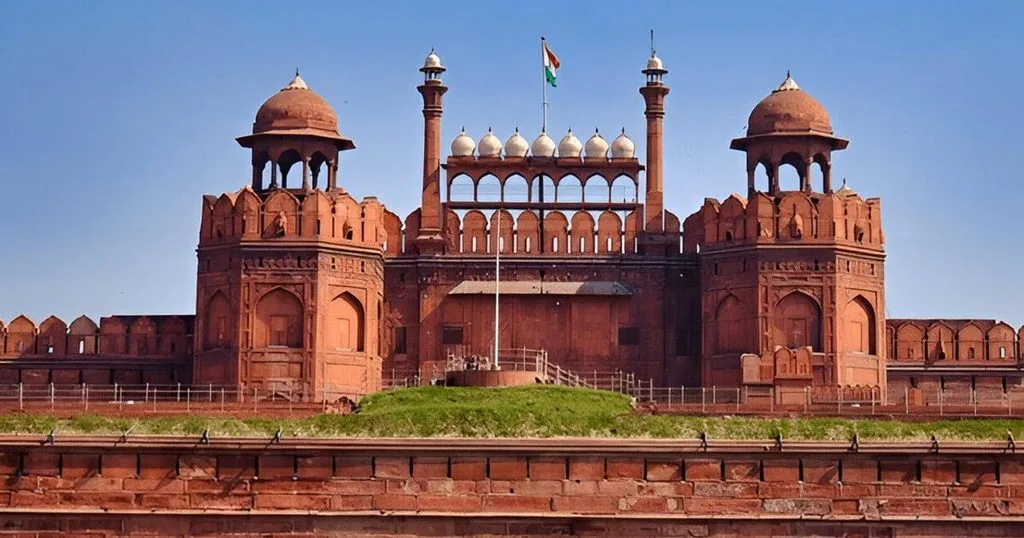
The name is literal. The curtain walls and the gates are red sandstone, running for a long way along Netaji Subhash Marg, and they are what the city sees. Inside, the halls the emperor actually used are white marble. Both materials, doing different jobs, in one enclosure — which is why the question of what the fort is made of has a two-part answer, set out on why it is called the Red Fort.
1857 and the garrison years
The single biggest change to the fort came after 1857, when the British cleared much of the interior and turned it into a garrison. That is the reason a visitor today walks across a lot of open ground between surviving buildings: the courtly structures that once filled those spaces are gone, and barracks stand in their place. Those barracks now house the museums. It explains almost every complaint I hear inside the fort about it feeling empty, and it is worth knowing before you go rather than after.
UNESCO, and 15 August
The fort was inscribed as a UNESCO World Heritage Site in 2007. Long before that it had acquired its modern role: every Independence Day the Prime Minister raises the flag and addresses the country from the Lahori Gate ramparts, which makes this the backdrop of the republic’s biggest annual speech. If someone asks why the Red Fort is famous, that is the one-line answer that covers both centuries. Access around 15 August is restricted for the ceremony, which is covered on the best time to visit.
| Roughly | What happened | What you see because of it |
|---|---|---|
| 1638–1648 | Built for Shahjahanabad | The planned processional layout |
| The 1600s | Sandstone walls, marble halls | Two materials in one enclosure |
| After 1857 | British clearances, garrison use | Open ground and barracks buildings |
| 2007 | UNESCO World Heritage listing | Its status as a protected site |
| Every 15 August | The Independence Day address | The ramparts you recognise on TV |
What works
- A single builder and a single decade, which makes the plan unusually legible
- Sandstone and marble in one site, doing visibly different jobs
- A continuous public role from the 1600s to the present-day flag ceremony
- UNESCO listing since 2007, with the protection that brings
Worth knowing
- Much of the Mughal interior was cleared after 1857 and is simply not there
- Barracks buildings sit where courtly structures stood, which reads oddly
- Very little on-site labelling ties the periods together for a visitor
- Access is restricted around the Independence Day address in mid-August
Read the empty ground as evidence rather than absence. The gaps between the surviving buildings are the clearest thing the fort has to say about 1857, and once you know that, the sparseness stops feeling like a disappointment.
Hearing it on site
None of this is written on the walls, which is the fort’s real weakness as a monument. The small-group guided tour, from $31, carries a 5.0 rating from 27 reviews — a small base, and I flag it every time it comes up, because 27 reviews is not a settled verdict. It is the higher-touch option for people who want the history properly rather than quickly. The alternatives are compared on the guided tours page.
Frequently asked questions
Who built the Red Fort in Delhi?
The Mughal emperor Shah Jahan, who also built the Taj Mahal. He raised it in the 1600s as the palace-fortress of his new capital Shahjahanabad — the Taj Mahal connection.
How long did it take to build the Red Fort?
Roughly a decade in the 1600s, with the dates commonly given as 1638 to 1648. It was built as one planned palace city rather than accumulating over centuries, which is why the layout reads so clearly.
Why does the Red Fort look empty inside?
Because after 1857 the British cleared much of the interior and used the fort as a garrison. The open ground and the barracks buildings date from that period — what survives inside.
Why is the Red Fort famous?
For being Shah Jahan’s palace-fortress, for its UNESCO World Heritage listing since 2007, and because the Prime Minister gives the Independence Day address from its ramparts every 15 August.